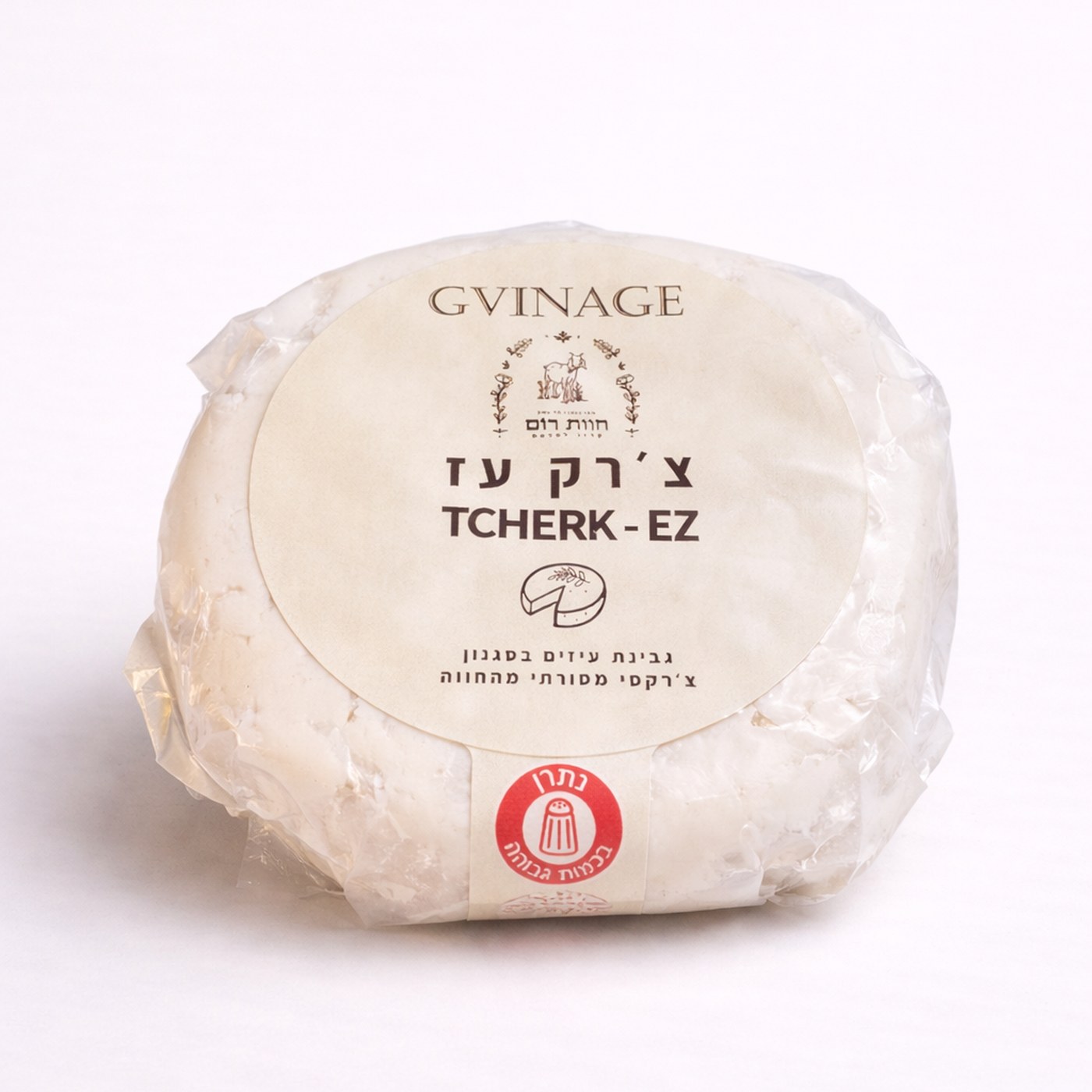
Tcherk-Ez is a fresh goat cheese in the traditional Circassian style, made from 100% pasteurized goat milk and ready for sale after two days. It has a semi-hard, supple, elastic texture and a clean, very delicate milky flavour.
 Goat milk
Its inspiration
A fresh goat cheese in the style of traditional Circassian cheese.
Making and ripening
Handmade from 100% pasteurized goat milk, and after just two days (with no long ageing) it is ready to sell and to eat. The short rest keeps the fresh, clean taste of the goat milk; Tcherk-Ez is all about simplicity, freshness and delicacy.
Taste and aromas
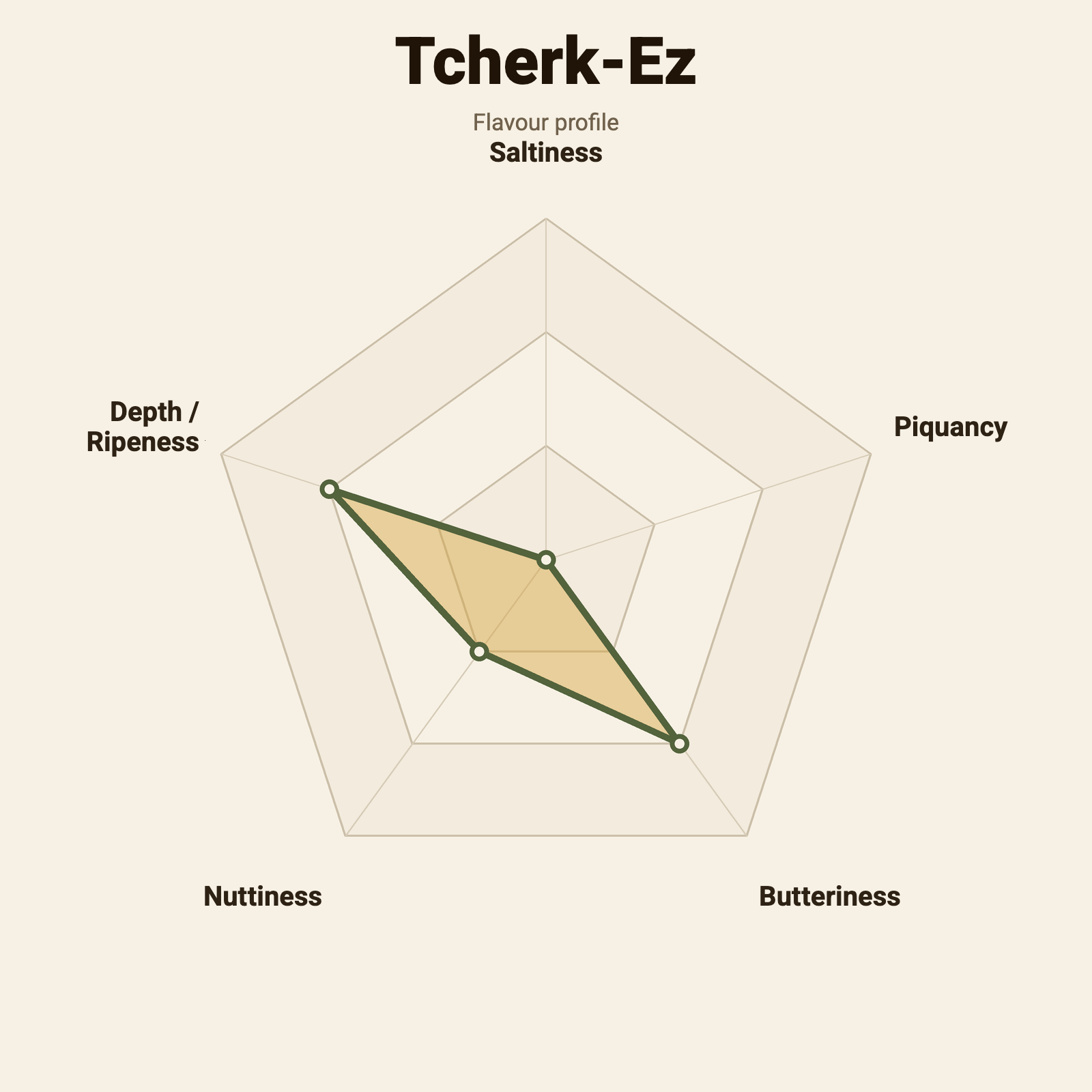
A semi-hard, supple, elastic texture — it can be sliced, cubed or crumbled by hand. Its firm structure suits heating: grilled or seared, it browns on the outside and softens inside, but keeps its shape and does not melt in the pan. Its flavour is milky, clean and very delicate, with a very subtle saltiness and a light acidity that adds balance and freshness.
Serving suggestion
Serve it as it is with fresh vegetables, olives, olive oil, za’atar and warm bread — ideal for a Mediterranean platter, salads, sandwiches, pastries, quiches and breakfast dishes. Recommended: sear it briefly in a pan or on the grill, creating a golden crust while the centre stays supple. When serving cold, take it out of the fridge about 20 minutes ahead.
“Circassian cheese, or Adyghe kuaye in the Circassian language, is a traditional cheese that originates in the Caucasus mountains. It was passed down from generation to generation as part of home and kitchen life, and also came to the Galilee with the Circassian community that settled in the villages of Kfar Kama and Rehaniya. It is a simple, direct cheese, with a firm yet delicate texture, a milky flavour and a pleasant saltiness.
The way it is made is very similar to ricotta: the liquid is heated, acidified, and the curd that rises and separates from it is gathered. But there is an essential difference — while ricotta is made from the whey left after making another cheese, Circassian cheese is made from whole milk. The result is a richer, fuller cheese, with a milky presence and a distinctive texture.
Local Circassian cheese is traditionally made from cow’s milk, but when I set out to make our version, it was clear to me that it too had to speak the language of Rom Farm. So I adapted the recipe to our goat milk, which gives the cheese freshness, depth and delicate pasture flavours.
And so “Tcherk-Ez” was born — a play on words joining Circassian cheese with the goats (“ez” in Hebrew) the milk comes from. The name reflects exactly what I wanted to create: a cheese that draws on an ancient regional tradition, but takes on a new interpretation through our herd, our land and our work.
“Tcherk-Ez” is a fresh cheese with a pleasant texture and a balanced flavour, which you can enjoy as it is or use in cooking and baking. To me, it tells a very Galilean story — a meeting between a tradition that came from the Caucasus, a community that preserved it for generations, and local goat milk that gives it a new voice.”
— Naomi Richard Stein, certified Master Cheesemaker, GVINAGE
Frequently asked questions about Tcherk-Ez
What is Tcherk-Ez made from?
Handmade from 100% pasteurized goat milk, and after just two days (with no long ageing) it is ready to sell and to eat. The short rest keeps the fresh, clean taste of the goat milk; Tcherk-Ez is all about simplicity, freshness and delicacy.
How should I serve Tcherk-Ez, and with which wine?
Serve it as it is with fresh vegetables, olives, olive oil, za’atar and warm bread — ideal for a Mediterranean platter, salads, sandwiches, pastries, quiches and breakfast dishes. Recommended: sear it briefly in a pan or on the grill, creating a golden crust while the centre stays supple. When serving cold, take it out of the fridge about 20 minutes ahead. Recommended wine pairing: Sauvignon Blanc.
How should I store Tcherk-Ez at home?
Wrap it in baking paper or parchment — not cling film, which suffocates the cheese and gives it an aftertaste — and place it loosely in a bag or box in the fridge, so the cheese can breathe without trapping excess moisture. The full guide: How to store cheese at home.